Why grassroots knowledge disappears, and what it takes to make it last.
African grassroots organisations are knowledge producers, not just programme implementers. This playbook documents what happens when you treat them that way.
The problem
A widow cooperative in Zambia operates successfully for five years. An organisation in Kenya resolves thousands of GBV cases through community paralegals. A framework in Uganda integrates economic agency with education, health, and cultural identity. These are not theories. They are operating models reaching real communities.
Then funding ends. Leadership changes. The organisation shuts down. Everything they learned, about what works, what does not, what conditions make solutions sustainable, disappears. No documentation. No transfer to peers. Years of community-embedded intelligence, gone.
The sector funds grassroots organisations to deliver services and pays consultants to produce knowledge. Grassroots organisations are doing both. Only one gets resourced.
What this playbook documents
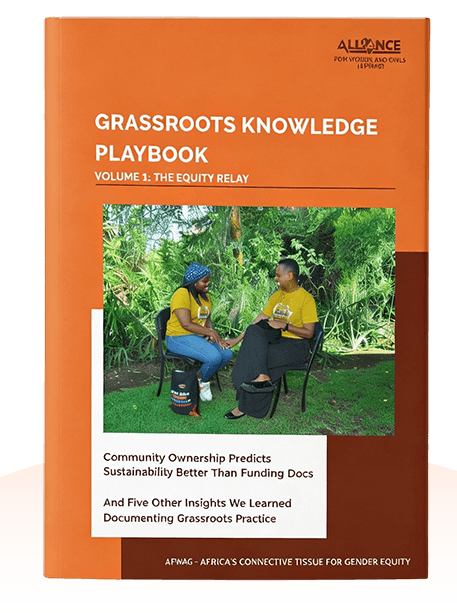
In March 2026, AFWAG ran a 22-day peer-to-peer knowledge exchange across 19 organisations in seven African countries. Each shared one homegrown solution to gender injustice. AFWAG provided editorial support, amplification, and documentation capacity. The result was 19 solutions documented, analysed, and made portable.
The exchange is the source. The insights it produced are what this playbook is about: what systematic documentation of grassroots practice reveals about how knowledge actually works, and why the development sector keeps funding the wrong things.
Six insights that challenge current practice
| # | Insight | What the evidence shows |
|---|---|---|
|
1 |
The knowledge gap runs both directions. |
Organisations where communities govern, control capital, and make decisions survive funding gaps. Organisations without that foundation collapse even when resourced. |
|
2 |
The knowledge gap runs both directions. |
Funders invest millions translating research into practice. Almost nothing is invested translating grassroots practice into research, policy, or funder strategy. |
|
3 |
Identical solutions built in isolation signal systemic failure. |
Five organisations across three countries independently built community paralegal models because formal courts do not reach rural women. That is not grassroots innovation. That is a continental pattern researchers and policymakers have missed. |
|
4 |
Economic agency is the entry point. |
Funders treat economic programmes as a standalone area. Organisations proved that economic interventions create conditions for addressing GBV, child marriage, school dropout, and health. Funding them separately loses the integration where impact actually happens. |
|
5 |
Grassroots organisations are knowledge producers. |
All 17 documented solutions were designed entirely within the communities they serve. The exchange generated 17 solutions in 30 days. Most research institutions could not match that pace. |
|
6 |
Peer exchange scales faster than training. |
Knowledge moved between organisations in real time: one contacted another to understand their informal settlements model, another requested a framework to adapt for a different context. No workshop fees. No international travel. No consultants. |
What is inside
- 17 documented solutions from Kenya, Zimbabwe, Zambia, Nigeria, Uganda, DRC, and Tunisia
- How grassroots knowledge circulates when documented systematically
- Strategic lessons for funders, policymakers, and ecosystem partners
- Organisation spotlights: what each solution does, what outcomes it has produced, and what conditions made it possible
- Systemic recommendations for continental-level change
Who should read this
Funders
Funders asking why organisations are not sustainable. You are funding the wrong things.
Policymakers
Policymakers wondering why progressive laws do not reach communities. Implementation infrastructure is missing.
Researchers
Researchers trying to understand what actually works. The evidence is embedded in practice you are not documenting.
Civil society networks
Civil society networks building peer exchange infrastructure. Structured exchange scales faster than workshops and costs less.
Download the playbook.
Enter your email to receive the full playbook and updates on how these solutions are travelling across borders.
"*" indicates required fields
You will receive the playbook immediately, along with occasional updates on solution adoption and peer knowledge exchange across the AFWAG network. Unsubscribe at any time
About the Equity Relay
The Equity Relay was AFWAG’s proof of concept: what happens when you resource grassroots organisations to document their knowledge systematically? Twenty organisations across seven countries participated in a 30-day peer-to-peer exchange. Each shared one homegrown solution. AFWAG provided editorial support, amplification, and documentation capacity.
The exchange demonstrated what is possible. The conclusion it produced is bigger: grassroots organisations are already generating knowledge. What is missing is the infrastructure to capture, document, and circulate it. This playbook shows what changes when that infrastructure exists.
Download the playbook to meet the organisations behind it.